"Just Pick a Niche" Is Terrible Advice for Most Entrepreneurs
You're staring at another "ideal client worksheet" — you know, the one that asks for your customer's age, income level, favorite coffee shop, and what they read on weekends.
Maybe you even gave them a cute name. "Marketing Mary" or "Entrepreneur Eddie."
You filled it out. You saved it. And then… nothing.
Because deep down, you knew this wasn't helping you figure out what to actually build or who to serve. It felt like busy work designed to make you feel productive without giving you any real clarity.
So you tried again. Different worksheet. Different framework. Different guru promising that if you just niche down enough, everything will click into place.
"B2B SaaS companies under $100K revenue with 3-5 employees."
"Health coaches for women over 40 in corporate careers."
"Marketing consultants serving local service businesses."
And every single time, something felt… wrong.
Too restrictive. Too arbitrary. Too focused on what people look like on paper instead of what they're actually trying to accomplish and who they really are… more than psychographics and demographics can capture.
Each of those worksheets feels like something is missing. Like you just don’t really quite have the grasp of it enough to design services, hire people, and really deliver for your “Marketing Mary.”
You start wondering what's wrong with you. Everyone else seems to have this figured out. Every business guru says "just pick a niche and commit." It's supposed to be simple.
But for you? It feels impossible.
Here's what nobody's telling you: The problem isn't you. The problem is you're being told to use documentation tools to do design work.
And that's like trying to build a house with interior decorating magazines.
Why "Just Pick a Niche" Is Terrible Advice
Let's get real about where this advice comes from and why it sounds so logical.
"The riches are in the niches."
"When you speak to everyone, you speak to no one."
"Focus is the key to business success."
All of these statements are true. Focus matters. Clarity attracts clients. Specialization does help you stand out.
But here's where the traditional advice goes catastrophically wrong:
It focuses on the wrong things.
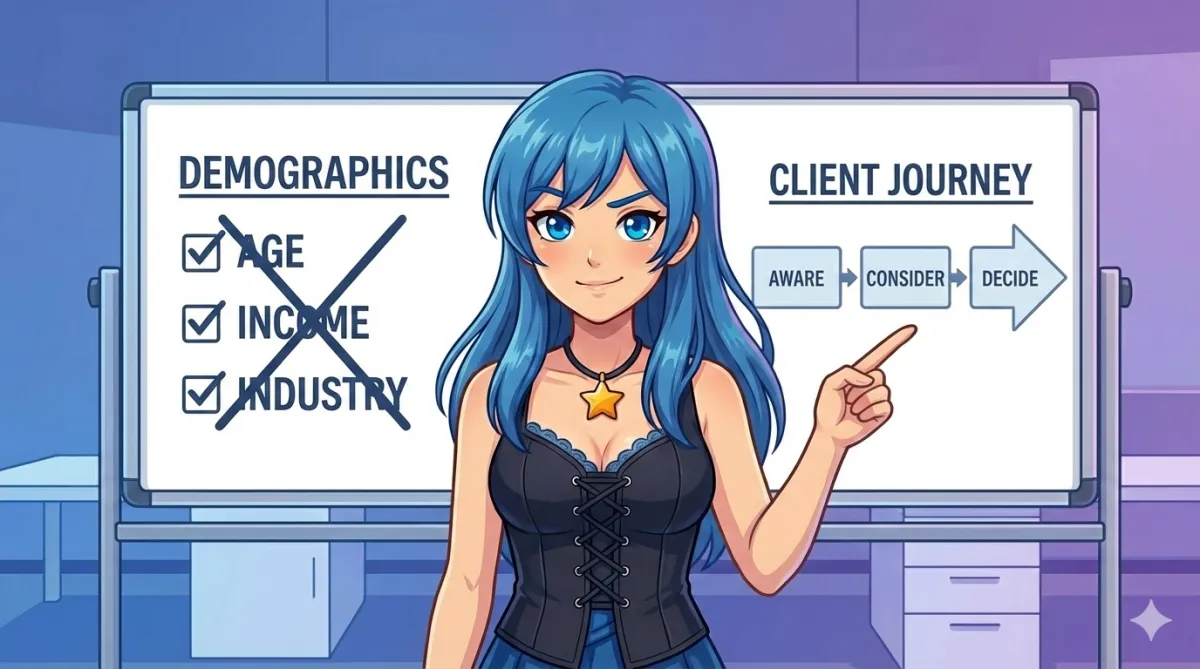
Traditional niching asks you to guess about demographics and business characteristics — age, income, industry, company size. These surface-level details don't tell you anything about the transformation someone is trying to create or where they are in their journey.
So you end up with a niche that sounds professional but doesn't actually help you design your business.
Most niching frameworks are documentation tools — they're designed to capture information about people who already buy from you so you can run better marketing campaigns.
But when you're just starting out or pivoting your business, you don't need documentation tools. You need business design tools that help you plan what should be.
The difference matters.
A documentation tool asks: "Who are your current customers?" (Useful after you've already figured out what you're building)
A business design tool asks: "What transformation journey are you supporting, and where can you create the most impact?" (Useful when you're designing your business foundations like what you sell and to who)
You'll still be making educated guesses — you haven't worked with enough clients yet, so you can't know everything with certainty.
But there's a massive difference between making strategic, research-backed guesses about transformation and journey stages versus making arbitrary guesses about demographics that don't inform what you actually build.
Even worse, most niching advice focuses entirely on demographics — what people look like on paper — instead of transformation — where they're going and what they're trying to accomplish.
So you end up with a niche that sounds good in theory:
"I serve tech startup founders between 30-45 years old with $500K-$2M in annual revenue who are based in major metropolitan areas."
Cool. Now what?
What are they struggling with? What keeps them up at night? What transformation are they trying to create? What set them on this path in the first place? What's motivating them to seek help right now? Where are they in their journey, and where do they want to go in 20 years?
The demographic niche tells you none of this.
And because it tells you nothing about their actual journey, you can't design products that truly help them. You can't create content that resonates deeply. You can't position yourself as the obvious choice.
You end up with a "niche" that looks professional on your website but doesn't actually inform how you build your business.
Here's who traditional niching advice actually works for:
Established businesses running specific marketing campaigns. If you already know your transformation, you've got proven offers, and you just need to target Facebook ads or write email copy for a product launch — sure, demographic niching helps you buy the right ads and write relevant copy.
Here's who it hurts:
New entrepreneurs trying to design their business foundation. People who need to figure out what to build, who to serve, and how to create real transformation — not just run a marketing campaign.
If you're in the second category and you've been beating yourself up for not being able to "just pick a niche and commit," you can stop now. You're not undisciplined. You're not unfocused. You're not overthinking it.
You're trying to use the wrong tool for the job you're actually trying to do.
The Real Problem: Documentation Tools vs. Design Tools
Let's talk about why traditional customer avatars and buyer personas keep failing you.
Here's the uncomfortable truth: Those templates you've been filling out? They're marketing tools, not business design tools.
Let me explain the difference, because this is crucial.
Documentation tools help you capture and organize information about something that already exists. They're designed to help you run specific campaigns or initiatives once you've already figured out what you're building.
Think about tools like:
DigitalMarketer's Before-After Grid — Maps out the transformation for one specific offer so you can write better sales copy
StoryBrand's Brandscript — Helps you craft messaging for a specific product or service you already have
Traditional buyer persona templates — Document characteristics of people who already buy from you so you can target similar prospects with better content
These are incredibly useful… after you know what you're building and who you serve.
They help you answer questions like: "How should I talk about this offer?" or "Which Facebook audience should I target?" or "What pain points should my landing page address?"
But they can't answer: "What should I build?" or "Who should I serve?" or "How do I create transformation?"
Those are business design questions. And trying to use documentation tools to answer design questions is why you feel stuck.
Business design tools help you plan what should be — they're frameworks for strategic thinking that inform what you build, who you serve, and how you structure your entire business.
You need a business design tool first. Documentation tools come later.
It's like trying to decorate a house before you've drawn up the blueprints and built the foundation. The decorating magazines are beautiful and inspiring, but they can't tell you where to put the walls to best support the load or where to put storage so the house is functional for the life you envision in it.
Enter P.A.M. — The Progressive Avatar Matrix
After watching hundreds of entrepreneurs struggle with traditional niching advice — and struggling with it myself through multiple businesses and business pivots over the years — I developed a framework that actually works as a business design tool.
It's called P.A.M. — the Progressive Avatar Matrix.
Here's what makes it different:
Instead of asking "what do your ideal clients look like right now," P.A.M. asks "what transformation journey are your ideal clients on, and where are they in that journey?"
Instead of creating a static snapshot, P.A.M. maps out the complete transformation your clients are working toward — a journey that typically spans 10-25 years.
Instead of forcing you to narrow down before you've done the work, P.A.M. helps you understand the full journey first, then strategically choose which part of that journey you want to focus on.
Here's how it works:
The 5 Levels
Your ideal clients aren't static. They're on a journey with roughly 5 distinct levels, each taking 2-5 years to complete on average — so you’re looking at a big chunk of their lives, 10-20 years or more.
For example, here’s a super simplified journey most entrepreneurs go through.
Level 1 might be "The Starter" — just beginning their journey, high energy but low structure
Level 2 might be "The Builder" — got some momentum, needs systems and first hires
Level 3 might be "The Grower" — has a team and revenue, stepping into true leadership
Level 4 might be "The Scaler" — thinking 10x, considering exits or major expansion
Level 5 might be "The Legacy Builder" — focused on lasting impact and influence
Your specific 5 levels will be completely different depending on what transformation journey you're supporting. But, notice how it’s not a lot of guesswork. We can read biographies and do research and see for ourselves what a typical journey looks like for our target client when we know what a truly successful version of them looks like.
The magic is that you don't have to serve all 5 levels. You pick ONE level transition to master at first — maybe you help Level 2s become Level 3s, or Level 1s become Level 2s.
That's your actual niche. Not demographics. Transformation + journey stage.
The P.A.T.H.W.A.Y. Framework
For each level, you map out seven key elements (this is where it gets really powerful):
P = Profile — What they look like at this level (situation, mindset, daily reality)
A = Assignments — Specific tasks they must complete to advance
T = Talents to Develop — Skills they're building at this stage
H = Hurdles — Obstacles blocking their progress
W = Wisdom You Provide — Your unique value at this stage
A = Aids and Assets — Tools and resources they'll use
Y = Yellow Lights — Warning signs they're not ready for help at this level
This framework was inspired by role-playing games like Dungeons & Dragons — stay with me here, even if you've never touched a 20-sided die.
In RPGs, character progression isn't just about hitting "Level 5" and calling it done. Characters develop dozens of sub-skills simultaneously — strength, dexterity, wisdom, specific abilities, overcoming weaknesses.
Your clients do the exact same thing. They're not just moving from "beginner" to "advanced." They're completing assignments, developing talents, overcoming hurdles, and acquiring resources all at the same time.
P.A.T.H.W.A.Y. helps you understand all that complexity so you can design products, content, and services that actually support the transformation.
What This Actually Looks Like: Traditional Niche vs. P.A.M. Niche
Let me show you the difference with a comparison of the same entrepreneur using both approaches:
Traditional Demographic Niching:
"I serve online coaches and consultants making $50K-$150K annually who work solo or with one VA and want to scale their business."
What this tells you:
Industry (coaching/consulting)
Revenue ($50K-$150K)
Team size (solo or 1 VA)
Business goal (want to scale)
What this DOESN'T tell you:
Who they are as a person
What's actually stopping them from scaling
What transformation they're trying to create
What's motivating them to seek help right now
Where they came from or where they're going next
What matters to them beyond revenue growth
P.A.M. Transformation Niching:
"I serve ambitious entrepreneurs who are transitioning from scattered hustle (Level 2) to strategic systems (Level 3) so they can build sustainable success without sacrificing their health and relationships."
What this tells you:
Who they are (ambitious entrepreneurs — likely making $50K-$150K, working solo or with minimal team)
Where they are (scattered hustle mode — doing everything themselves, constantly overwhelmed)
Where they're going (strategic systems — organized, scalable, sustainable)
What matters to them (not just revenue — their health, relationships, and life quality)
What transformation you create (from chaos to strategic clarity)
What's blocking them (the scattered approach that's working somewhat but burning them out)
See the difference?
Both descriptions could be talking about the exact same person at the same revenue level with the same team size.
But the first focuses on business characteristics. The second focuses on the human being running that business and the specific transition they're trying to make.
The first could apply to hundreds of different struggles. The second is specific about the exact transition you help with — from scattered hustle to strategic systems.
The first gives you almost no information about how to create products and services or build a team that could help them. The second tells you exactly what they need to move from Level 2 to Level 3 AND get one step closer to their dream Level 5 life.
How P.A.M. Replaces Traditional Niching (And Why It Works Better)
When you use P.A.M. instead of traditional demographic niching, everything about your business becomes clearer and more strategic:
Instead of demographics → You focus on transformation + journey stage
You're not just serving "women over 40" or "tech startups under $100K." You're serving people making a specific transition in their journey. That's way more focused because it tells you exactly what they need help with.
Instead of "narrow down immediately" → You map the full journey, then pick ONE level transition to master
Traditional advice forces you to narrow down before you understand the landscape. P.A.M. says: understand the complete 10-25 year transformation journey first, then strategically choose which 2-5 year transition you want to focus on.
This feels less restrictive because you're not arbitrarily eliminating people. You're acknowledging that people at different stages need different support — and you're choosing where you can create the most impact right now while leaving room open to form partnerships or referral relationships with experts that serve other levels.
Instead of "create persona and move on" → You design your entire business around this journey
Traditional personas live in a folder you never look at again. Your P.A.M. becomes the foundation for everything:
Content strategy — You know exactly what challenges to address at each level, so you never run out of content ideas
Product roadmap — You see where new offers fit and what your clients need next as they progress
Partnership opportunities — You can refer people to experts who serve other levels and receive referrals back
Sales qualification — You can spot someone's level in 30 seconds of conversation and know if they're ready for you
Positioning — You speak directly to the specific transition pain points your ideal clients are experiencing right now
Most importantly, P.A.M. gives you confidence.
You're not guessing about who to serve or what to build. You understand the complete transformation you're creating, where someone needs to be to work with you successfully, and what success looks like at each stage.
"But I Need Clients NOW" — Why Pattern Recognition Comes FROM Doing the Work
I know what you're thinking: "This all sounds great, but I need clients NOW. I can't wait years to figure out my niche."
Here's the good news: You don't have to.
Let me give you an analogy that makes this clear.
You can't write a perfect recipe before you've ever made the dish. But you also can't wait until you've made it 100 times before you write anything down.
What you can do is this: Write down your best educated guess at the recipe, make the dish, notice what worked and what didn't, update your recipe, and do it again.
That's exactly how P.A.M. works.
You fill out your P.A.M. based on research, educated guesses, and what you currently understand about your ideal client's transformation journey. Then you design your business around it — your offers, your positioning, your messaging.
Then you start working with clients at your focus level.
And here's where the magic happens: Every client teaches you something that makes your P.A.M. more accurate.
You notice:
"Oh, this hurdle shows up even more often than I thought"
"This assignment is actually what they need to complete first before that other one"
"People at Level 2 struggle with X way more than my research suggested"
"The clients who get the best results all have this specific characteristic"
"This yellow light warning sign is actually the most important one"
You update your P.A.M. Your recipe gets better. Your positioning gets sharper. You get faster at spotting who's ready for you and who's not.
This isn't "waiting years to niche." This is making strategic decisions now that you continuously refine through real experience.
And here's something powerful that happens over time: When you focus on helping people transition from Level 2 to Level 3, you naturally create a pipeline of Level 3 clients.
As your clients progress, it becomes natural to expand your services to help them transition from Level 3 to Level 4. You're not pivoting to a completely different niche — you're growing with your clients as they advance through their journey.
This is way more sustainable than traditional niching where you might serve "tech startups under $100K" and then decide to completely pivot to serve "e-commerce businesses" — forcing you to start over from scratch.
With P.A.M., your business evolves naturally as your clients progress. You're building on what you already know, not abandoning it.
You're 10 case studies away from everything changing. Ten clients who you take from your focus level to the next level. Ten success stories that prove your approach works. Ten people who will refer others because you genuinely transformed their business and their life.
It might take 30+ clients to find your perfect 10 case studies. That's normal. The journey matters because each client teaches you something that makes your approach even better.
But you're not wandering aimlessly. You have P.A.M. as your foundation — a strategic framework that tells you who you're looking for, what transformation you're creating, and what success looks like at each stage.
Every client you work with either validates what you mapped out or teaches you how to refine it. That's not guessing. That's strategic iteration.
When to Use Traditional Niching vs. P.A.M.
Let me be clear: I'm not saying demographic niching is always wrong. I'm saying it's the wrong tool for certain jobs.
Use traditional demographic niching when:
You're running a specific marketing campaign and need to target ads
You already know your transformation and have proven offers
You need to write copy for a specific product launch
You're documenting who your current best clients are so you can find more like them
Use P.A.M. transformation niching when:
You're designing your business foundation for the first time
You're creating your product stack and need to understand what to build
You're building long-term strategy, not just running a campaign
You need to understand where clients come from and where they go next
You want strategic partnerships with people serving other stages
You're trying to figure out what transformation you actually create
The pattern you'll notice: Documentation tasks use demographic niching. Business design tasks use transformation niching.
And here's the rebel truth nobody wants to say out loud: You don't have to choose demographic niching just because every guru says you should.
If focusing on transformation + journey stage feels more authentic and useful than focusing on age/income/industry characteristics, trust that instinct.
Your business design doesn't have to look like everyone else's. Especially if your brain works differently than the people writing the traditional advice.
How to Actually Use P.A.M. to Find Your Niche
Okay, enough theory. Let me walk you through the actual process.
Step 1: Define Your Hero
Start by completing this sentence:
"My hero is [who they are] who wants [what they want] so they can [the deeper why]."
Example: "My hero is a passionate, ambitious misfit entrepreneur who wants to make a significant impact so they can leave a lasting legacy and share their success with others."
Notice this isn't demographics. It's about who they are as a person and what they're trying to accomplish with their life and business.
This is your North Star. Everything else builds from here.
Step 2: Map the 5-Level Journey
Now sketch out the 5 levels of transformation for this hero:
Where do they start? (Level 1)
Where do they go from there? (Levels 2-4)
Where do they end up if the full transformation is successful? (Level 5)
Don't overthink this. You're creating a rough draft, not a perfect document. You can always refine it later.
For each level, give it a name and write a brief description of what's happening for them at this stage. What are they struggling with? What's their mindset like? What does their daily reality look like?
Step 3: Fill Out P.A.T.H.W.A.Y. for Each Level
This is the detailed work, but it's worth it. For each of your 5 levels, map out:
Profile: What they look like at this level
Assignments: Tasks they need to complete to advance
Talents: Skills they're developing
Hurdles: Obstacles blocking their progress
Wisdom: What you (or an expert) provides to help them
Aids/Assets: Tools and resources they'll use
Yellow Lights: Warning signs they're not ready for help
Pro tip: Use AI as your research assistant for this. Ask it to find industry research, case studies, and patterns for people at each level. But YOU evaluate which suggestions match reality and add nuance from your experience. Don't just copy-paste AI responses.
Step 4: Choose Your Focus Level Transition
Look at everything you've mapped. Which transition excites you most? Where can you make the biggest impact right now?
Pick ONE level transition to master. Maybe you help Level 2s become Level 3s, or Level 1s become Level 2s.
That's your focus. That's your niche.
Not "women over 40." Not "tech startups under $100K."
Your niche is: "I help [Level X people] become [Level Y people] by [the transformation you create]."
Step 5: Build Your 10 Case Studies
Now work with people at your focus level. Help them make the transition. Notice patterns. Refine your approach.
Your niche will become crystal clear as you do this work. You'll start seeing exactly:
What language resonates with people at this level
What hurdles consistently block progress
What your unique wisdom actually is
How to spot someone who's ready vs. not ready
What products and services would serve this transition best
This isn't guessing anymore. This is pattern recognition based on real transformation you're creating.
Your Niche Isn't Demographics — It's Transformation + Journey Stage
Let me reframe what "niche" actually means, because I think the word itself has been corrupted by bad advice.
Your niche isn't who your clients are on paper. Your niche is the specific transformation you create for people at a specific stage in their journey.
When you say "I serve ambitious entrepreneurs transitioning from scattered hustle to strategic systems," you're being incredibly focused:
You're not serving ALL ambitious entrepreneurs
You're serving the ones making THIS specific transition
You understand exactly where they're coming from
You know exactly where they're going
You can design everything around supporting that movement
This is actually MORE focused than demographic niching, not less.
"Women over 40" could include a newbie entrepreneur, a CEO scaling to 8 figures, and someone thinking about retirement. That's not focused — that's vague dressed up as specificity.
But "entrepreneurs transitioning from Level 2 to Level 3" is laser-focused. You know exactly what they need, when they need it, and how to help them.
And here's the magic: This gives you the focus you need without the restriction you fear.
You're not arbitrarily excluding people. You're acknowledging that people at different stages need different support, and you're choosing where you can create the most transformation right now.
As clients naturally progress through levels, you can expand to serve them at their next stage. Or you can build strategic partnerships with people who specialize in other levels. Or you can stay focused on this one transition and become THE expert everyone refers to.
That's real freedom. Not the fake freedom of "serve everyone poorly." Not the prison of demographic boxes that don't match how you think.
The freedom of knowing exactly who you serve, how you help them, and what success looks like — while building a business that works with your brain instead of against it.
You're 10 Case Studies Away
Here's what nobody tells you about building a business: You're probably about 10 solid case studies away from everything changing.
Ten clients who you take from your focus level to the next level.
Ten success stories that prove your approach works.
Ten people who will refer others because you genuinely transformed their business and their life.
It might take 30+ clients to find your perfect 10. That's normal. The journey matters because each client teaches you something that makes your approach even better.
But now, with P.A.M., you know exactly who those 10 people are:
Who they are as human beings (your hero statement)
Where they are in their journey (your focus level)
Where they're going (the next level)
What they need from you to get there (your P.A.T.H.W.A.Y. wisdom)
You're not guessing anymore. You're not forcing yourself into demographic boxes that don't fit. You're not using documentation tools to try to do design work.
You have a real business design framework that understands transformation as a journey, not a transaction.
When you focus on ONE level transition and serve it exceptionally well, those case studies compound. Each success story makes the next sale easier. Each transformation refines your approach. Each client becomes a referral source for more people at that exact level.
This is how you build momentum instead of constantly starting over.
You don't need to force yourself into a demographic box that doesn't fit your brain or your business.
You need to understand the transformation journey you're supporting, pick the stage where you can create the most impact, and build your 10 case studies.
Ready to map your complete client journey and find your real niche?
Join the free BLUEprint Business Lab for the complete P.A.M. training, including:
Full P.A.T.H.W.A.Y. framework templates
AI prompts for research and brainstorming
Examples from multiple industries
Community support from entrepreneurs doing this work alongside you
Join BPBizLab (completely free) →
If you're feeling stuck on designing your business foundation and need expert eyes to diagnose what's actually blocking you, a Sprint Session gives you 4 hours of focused strategy with 30 days of implementation support.